
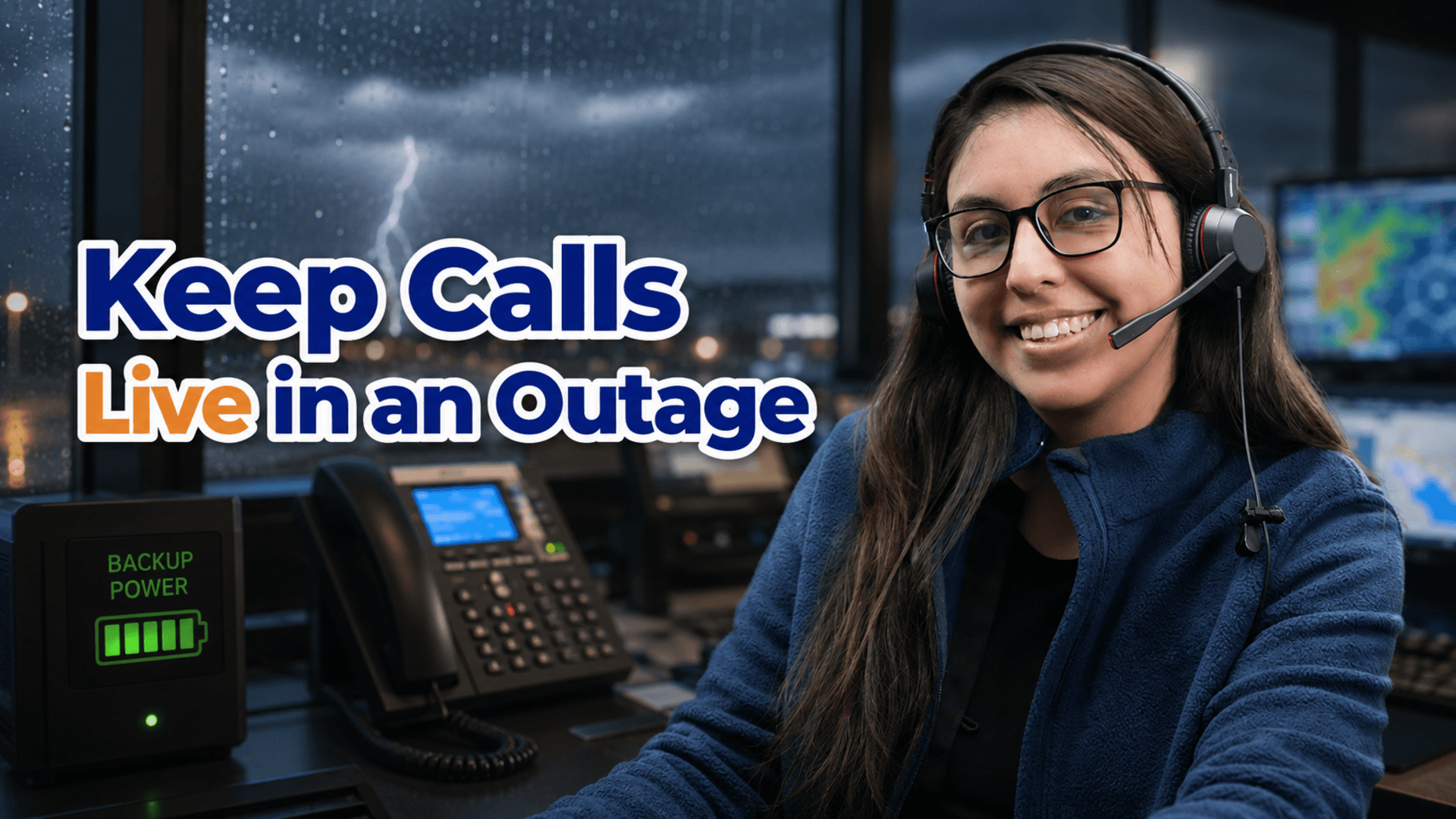
Call continuity keeps customers, staff, and partners able to reach your business during an outage. A disaster recovery answering service adds a separate place to receive calls, share approved updates, capture urgent needs, and route messages while your main office recovers.
It is one layer of a business continuity plan. It does not replace backup power, internet, data recovery, safety procedures, or crisis leadership.
What Is Call Continuity?
Call continuity is the ability to keep inbound phone communication working when normal systems or staff are unavailable. The disruption may be a power failure, carrier outage, cyber event, severe weather, building closure, or sudden call surge.
The goal is not to pretend nothing happened. The goal is to give callers accurate information and a working path to help.
Ready.gov says business emergency planning should include communications, IT recovery, and continuity plans. Its business emergency planning guidance notes that customers, employees, and public officials may all need timely information.
How a Disaster Recovery Answering Service Helps
An answering service receives calls outside your affected office or phone system. It can use a prepared crisis script, collect messages, route urgent calls, and share approved status updates.
Ambs Call Center describes geographically separated facilities, backup power, carrier failover, and redundant systems on its live disaster recovery and redundancy page.
Your own plan still needs a way to forward or reroute calls to that service. Test the route before an outage.
Identify Single Points of Failure
Walk the call from the public number to the person or system that handles it. List every carrier, device, internet link, power source, facility, application, and person in the path.
- One carrier or phone platform
- One office internet connection
- One on-site phone appliance
- One administrator with routing access
- One mobile number for all urgent calls
- One office that holds the call script
- One system for messages and contacts
Reduce the risks that matter most. A backup answering service helps with inbound calls, but only if the public number and routing remain reachable.
Build Call Failover before an Outage
Failover is the switch from the main call path to a backup. It may be automatic after a system failure or manual when an authorized person activates it.
Define the trigger, owner, and return step. Decide how the team confirms that backup agents are receiving calls. Keep more than one person able to make the change.
Test several failure cases. Turn off the office internet. Make the main line busy. Route calls when nobody can enter the building. Check inbound calls, caller ID, transfers, and messages.
Prepare Crisis Call Scripts
Write scripts before the emergency. Agents need approved facts, not guesses. Use versions for staff, customers, vendors, media, and public agencies when needed.
A crisis script can include:
- What service is affected
- What remains available
- Who can receive urgent calls
- Where callers can find updates
- What information the agent collects
- Which statements agents must not make
- When the script expires or needs review
Keep messages short. Add a timestamp to every status update. Old crisis information can cause more harm than a simple statement that the team is reviewing the issue.
Route Urgent Calls during a Disruption
Normal contact lists may fail during a regional event. Add primary and backup people in different locations and on different networks when possible.
Define urgent categories and the number of attempts. Tell the answering service what to do when every contact fails. Include emergency services and public safety paths where appropriate.
Ambs Call Center's emergency answering service includes live screening, on-call notification, continued escalation, and reporting for approved workflows.

Protect Data and Access during Recovery
A crisis is not a reason to share more data than needed. Decide what backup agents can see, where messages go, and who may update scripts.
Use named accounts and strong access controls. Remove temporary access after recovery. Keep a record of urgent changes and messages.
If the outage involves a cyber event, coordinate call handling with the incident response team. Do not place unapproved details in scripts or tell callers a cause that has not been confirmed.
Test Call Continuity with Tabletop Exercises
Run a short exercise every year and after major system changes. Give the team a scenario, such as a carrier outage and office closure.
- Activate the backup route.
- Publish the approved script.
- Place customer and staff test calls.
- Trigger an urgent escalation.
- Simulate a failed primary contact.
- Review message delivery and access.
- Return calls to the main path.
Record the time, errors, and decisions. Assign owners and dates for each fix.
Call Continuity Checklist
- Public numbers and number ownership documented
- Automatic and manual routing steps tested
- Backup answering capacity confirmed
- Crisis scripts approved and timestamped
- Primary and backup contacts current
- Urgent escalation and failed-contact path tested
- Secure message delivery available
- Return-to-normal process documented
For larger support needs, Ambs Call Center's call center services can provide a defined inbound process beyond basic messages.
Plan for Different Outage Scenarios
A storm, carrier failure, power loss, cyber incident, and building evacuation do not create the same phone problem. Write a short call plan for each likely scenario. State which number fails over, what agents may tell callers, which services remain available, and who can approve a change to the message.
Include partial failures. Your office may have internet but no phone service, or working phones but no access to customer records. A disaster recovery answering service can preserve the human contact point while your internal systems recover, but agents need an approved response when account data or scheduling tools are unavailable.
Set Recovery Priorities for Call Types
Rank calls before a disruption. Life-safety and emergency issues may require public emergency services or a trained on-call team. Active customer incidents may come next, followed by time-sensitive sales, routine support, and general messages. This order helps agents handle limited capacity consistently.
For each tier, define the minimum information to capture, the contact path, the acknowledgment time, and the fallback. Avoid a single group message that alerts everyone. It creates noise and makes ownership unclear during the period when your team has the least attention to spare.
Coordinate Phone Recovery with Business Recovery
Call continuity belongs inside the wider emergency plan. Ready.gov recommends that businesses develop emergency plans around communications, resources, and continuity. Connect the phone plan to your incident leadership, employee notification, vendor contacts, alternate work location, and public updates.
Assign one person to keep the answering team informed and another as backup. Record changes with a timestamp so agents know which status message is current. When normal service returns, tell the provider when to stop the emergency script and where any unresolved messages should go.
Review What Happened after Every Event
After a test or real outage, compare the plan with what callers experienced. Check failover time, abandoned calls, message accuracy, escalation acknowledgments, and repeated questions. Ask employees whether urgent alerts reached the right person and whether routine messages were easy to recover later.
Turn findings into specific changes, such as a shorter forwarding delay, another backup contact, a clearer public message, or offline access to a critical phone list. Then retest the changed step. Continuity improves through small, verified corrections.
Maintain the Plan between Tests
A failover plan can become stale even when the phone system does not change. Employees leave, vendors update numbers, office hours shift, and new services create new call types. Assign an owner to review contacts and scripts at least quarterly and after any major operational change.
Store an accessible copy of the activation steps outside the system most likely to fail. Include the carrier contact, answering-service contact, forwarding instructions, approval roles, and the last test date. Protect credentials separately; a continuity checklist should not expose passwords.
Give new incident leaders a short orientation before they need it. They should know how to activate coverage, approve a caller message, check that routing is working, and return calls to normal. A clear handoff keeps resilience from depending on one employee's memory.

Frequently Asked Questions
Is call forwarding enough for disaster recovery?
It is one part. You also need a working destination, trained staff, scripts, contacts, message delivery, and a failure path.
Can failover be automatic?
Many phone systems support automatic rules. Keep a manual option and test both. Confirm who can change and restore routing.
What should agents tell callers during an outage?
Only approved, current facts. State what is affected, what callers can do, and when or where the next update will appear.
How often should we test?
Test on a set schedule and after major phone, facility, staffing, or provider changes. High-risk operations may need more frequent tests.
Does an answering service replace a continuity plan?
No. It is a communications layer within a wider plan for people, facilities, IT, data, vendors, and recovery.
Keep Your Business Reachable with Ambs Call Center
An outage should not leave callers guessing. A tested backup route and approved call plan keep information moving while your team recovers.
Ambs Call Center can help you build live call continuity around routing, scripts, urgent contacts, and redundant answering operations.