
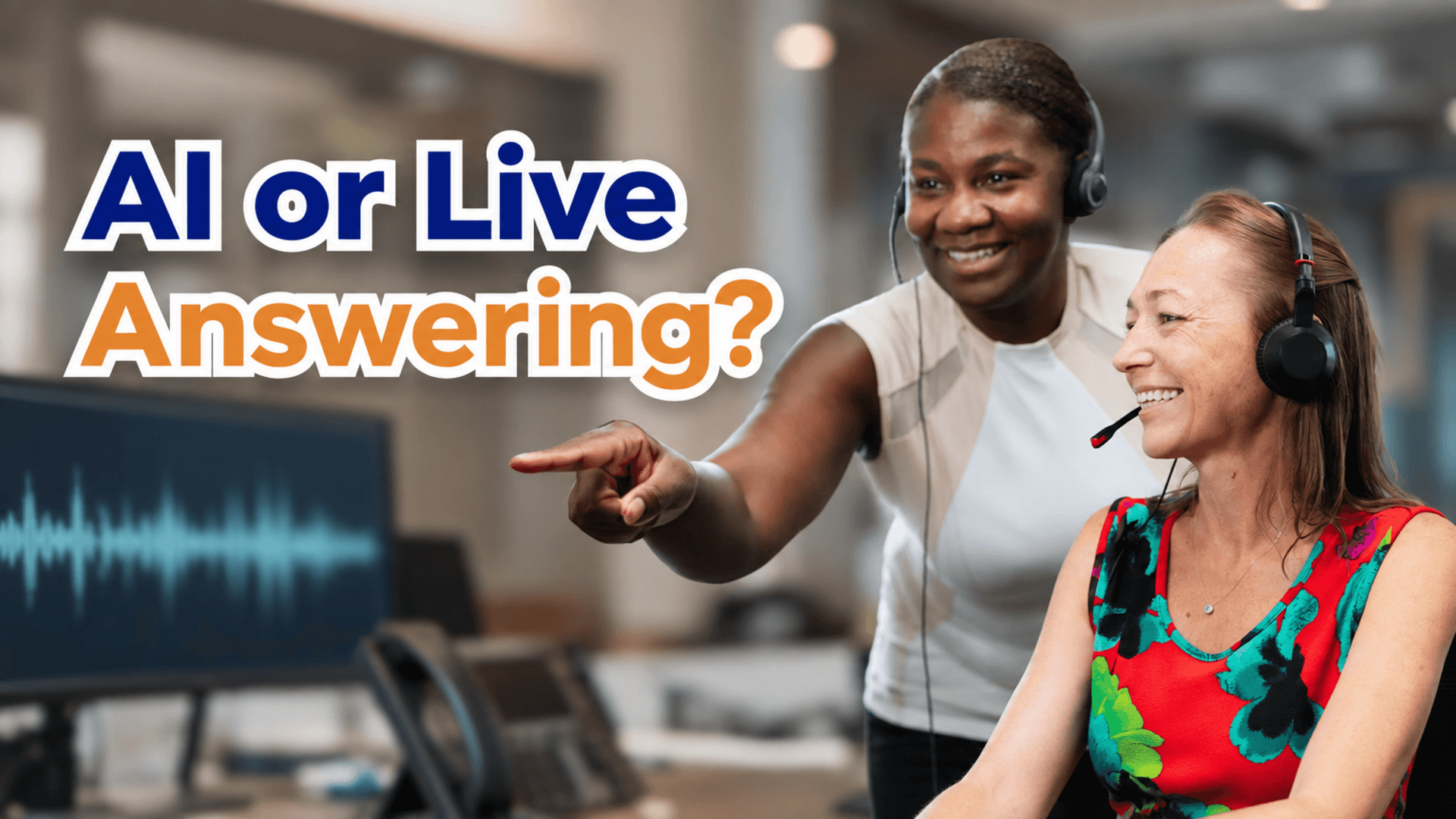
An AI answering service can respond fast, follow a set process, and handle several routine calls at once. A live agent brings human judgment, empathy, and flexibility to calls that do not fit a clean script. Many businesses need both.
The right choice depends on the work, not the trend. Start with your call types, risks, caller needs, and budget. Then decide which calls can be automated and which should reach a trained person.
What Is an AI Answering Service?
An AI answering service uses a voice system to hold a conversation with callers. It may answer common questions, collect contact details, book an appointment, route a call, or send a summary.
The system follows instructions and business data supplied during setup. It can be available around the clock and can scale during sudden call spikes. Its results depend on the quality of the data, prompts, integrations, tests, and limits behind it.
Ambs Call Center offers an AI receptionist with options for human support.
What Is a Live Agent Answering Service?
A live answering service uses trained people to answer for your company. Agents follow scripts, but they can hear emotion, ask a clarifying question, and adapt when a caller explains something in an unusual way.
Live agents can take messages, transfer calls, schedule, screen leads, and follow on-call rules. They are often a better fit when the call is sensitive, urgent, detailed, or hard to predict.
Human service also has limits. Agents need training, staffing, and quality checks. Hold times can grow during a surge. Different people may phrase the same step in different ways.
AI vs. Live Answering Service: Side-by-Side
|
Factor |
AI answering service |
Live agent service |
|---|---|---|
|
Availability |
Can run 24/7 and answer parallel calls |
24/7 is available when the provider staffs it |
|
Consistency |
Repeats configured rules in a steady way |
Uses scripts with natural human variation |
|
Empathy |
Can use empathetic language but does not feel emotion |
Can respond to tone and emotional context |
|
Complex calls |
Best when paths and limits are clear |
Better able to clarify and adapt |
|
Scaling |
Can add call capacity quickly |
Needs enough trained agents on shift |
|
Pricing |
Often flat, usage, or conversation based |
Often per minute, per call, or bundled |
These are common patterns, not promises. Compare the live terms and test the same calls with each service.
Where AI Answering Services Work Well
AI can be strong when calls are frequent, repeatable, and low risk. It can capture names, numbers, service needs, locations, and approved appointment choices. It can also answer routine questions from a maintained knowledge base.
- Office hours and location questions
- Basic lead capture
- Appointment requests with simple rules
- After-hours messages
- Call routing by department or service
- High-volume overflow with a clear fallback
AI also makes testing repeatable. You can run the same call after each change and see whether the system follows the new rule.
Where Live Agents Are Stronger
Humans are often better when a caller is upset, confused, or unable to explain the issue in expected terms. A trained agent can slow down, ask a new question, and recognize that the call needs a different path.
Live service may be the better default for sensitive legal intake, complex patient calls, urgent dispatch, high-value sales, complaints, and conversations where trust depends on a human response.
Do not assume every human agent is automatically good. Training, turnover, supervision, scripts, and account knowledge still shape the result.
Accuracy Depends on the Kind of Call
An AI system can be very accurate with clean names, common questions, and structured choices. It may struggle with noise, strong accents, unusual names, poor connections, interruptions, or facts outside its data.
A human can clarify those details, but people can also mishear, mistype, or skip a field. Compare accuracy by field and call type. Do not rely on one overall score.
Test addresses, phone numbers, dates, product names, industry terms, and emotional callers. Review what happens when confidence is low. A safe system should ask again or transfer instead of inventing an answer.

Caller Trust and AI Disclosure
Callers should not be tricked into believing software is a person. Use a clear, natural disclosure when AI answers. Tell the caller how to reach a human when one is available.
Public views of AI are mixed. Pew Research Center found that U.S. adults were more concerned than excited about growing AI use and wanted more control over how it affects their lives. That supports a simple buying rule: give callers clear information and a sensible human path.
Review the Pew Research Center findings on public and expert views of AI when you plan disclosure and caller choice.
Why a Hybrid Answering Service Often Works Best
A hybrid model assigns routine work to AI and routes harder calls to people. It does not mean every call moves between both. The design should say which model starts each call and what triggers a handoff.
For example, AI may answer overflow, gather the caller's name and need, then transfer an urgent or sensitive call to a live agent. A live agent may answer first and use automation to book or create the record.
Good handoffs include context. The caller should not repeat the whole story. The agent should see what the system collected and know why the call was transferred.
Compare Cost without Ignoring Risk
AI and live services often use different billing units. AI plans may charge by call, conversation, minute, or monthly tier. Human services often use minutes, calls, or bundles. Convert both quotes into a monthly total for the same workload.
Then include failure cost. A wrong appointment, missed urgent transfer, or poor answer can cost more than the unit rate saved. Give high-risk calls more human review even when that choice costs more.
Also count staff time. A low-cost system that sends unclear messages creates work for your team. A higher-cost call that completes intake or booking may remove phone tag and data entry.
Privacy, Security, and Connected Systems
Both models can handle private data. Both can create risk. Map recordings, transcripts, messages, user accounts, and integrations before launch.
Ask an AI provider which data is used to run the call, improve the product, or train models. Review retention, deletion, access, subcontractors, and incident notice. Ask the same core questions of a live answering service.
If calls involve regulated data, bring in privacy, security, compliance, and legal teams. A contract claim does not replace your own review and configuration.
Test the Same Call in Every Model
Create a scorecard for accuracy, tone, completion, time, and handoff. Run the same scenarios through AI, live agents, and the proposed hybrid path.
Include an easy booking, a hard name, a noisy call, an emotional caller, an urgent phrase, a request outside scope, and a caller who changes direction. Check the final record as closely as the call.
Do not test only a polished vendor demo. Use your services, hours, locations, and rules. Repeat the test after changes and review real outcomes once the system is live.
How to Design AI-to-Human Escalation
- List hard stops. Identify topics the AI must not handle.
- Define signals. Use urgency words, repeated confusion, caller requests, and low confidence.
- Choose the human queue. Route by time, call type, and skill.
- Pass context. Send the transcript, fields, and handoff reason.
- Plan failure. Decide what happens when no person is available.
- Review outcomes. Track transfers, repeat questions, and dropped calls.
Ambs Call Center compares current tools in its guide to the best AI answering services. Verify every listed feature with the provider and your own test calls.
How to Choose AI, Live Agents, or Both
- Choose AI-first for routine, high-volume, structured calls.
- Choose live-first for sensitive, complex, or high-judgment calls.
- Choose hybrid when calls vary and a clean handoff is possible.
- Keep voicemail only for callers who prefer it or when no action is needed.
Run at least ten test calls before launch. Include background noise, an unclear answer, a caller asking for a person, a task outside scope, and a failed transfer. Monitor real calls and update the design.
Ambs Call Center also provides a live phone answering service for companies that want trained human agents on their call flow.
Set an Escalation Path for AI Failures
Automation needs a graceful exit. Decide how many times the system may ask a caller to repeat, which words trigger a live transfer, and what happens when the integration or calendar is unavailable. Tell callers when they are interacting with automation and give them a practical way to reach a person.
Review failed and abandoned conversations by reason. Repeated failures around accents, background noise, names, or unusual requests show where the workflow needs a live fallback or better design.

Frequently Asked Questions
Is an AI answering service cheaper than live agents?
It often has a different cost structure and may cost less for routine volume. Compare total price, completed tasks, error handling, and human backup. Cheap calls do not help when the workflow fails.
Can AI handle emergency calls?
It can follow approved screening and routing rules. High-risk calls need clear limits, human escalation, and a failure plan. Do not ask AI to make professional judgments outside its role.
Will callers know they are speaking with AI?
They should receive a clear disclosure. Give callers a simple way to ask for a person when that option is part of the service.
Can live agents use AI?
Yes. AI can help with notes, routing, knowledge search, and records while a human leads the call. Review accuracy, privacy, and agent responsibility.
Which model is best after hours?
It depends on the calls. Routine messages may suit AI. Sensitive or urgent calls may need a live agent. A hybrid design can sort and escalate.
How often should we review the system?
Review it after launch, after major changes, and on a set schedule. Track errors, transfers, caller requests, outcomes, and new questions.
Build the Right AI and Human Mix with Ambs Call Center
You do not have to choose technology or people for every call. Choose the right handler for each job, then make the handoff easy.
Ambs Call Center can help you map routine, complex, urgent, and after-hours calls across AI, live agent, or hybrid coverage.